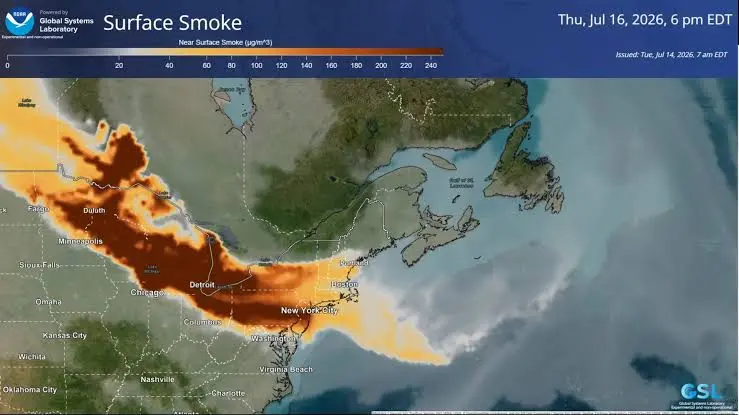
Wildfire Smoke Blankets the North: The Current Air Quality Crisis
Hazy skies and compromised air quality are stretching across the northern United States, from Wisconsin all the way to Massachusetts. Driven by active wildfires in Ontario, Canada, and northern Minnesota, dense plumes of smoke are drifting south, prompting municipal health warnings and a massive surge in demand for residential air filtration.
The National Weather Service (NWS) in Boston has reported highly visible haze and distinct smoke odors reaching coastal New England. In response, the Massachusetts Department of Environmental Protection (MassDEP) issued official air quality alerts, warning that current conditions are highly unhealthy for sensitive groups.
Who is Most at Risk from Wildfire Smoke?
- Children and Older Adults: Developing lungs and aging respiratory systems are highly sensitive to particle pollution.
- Individuals with Pre-existing Conditions: Anyone diagnosed with asthma, chronic obstructive pulmonary disease (COPD), or cardiovascular/heart disease should limit outdoor exposure.
- Active Outdoor Workers: High-exertion outdoor activities during alerts can force fine particulates deep into the lungs.
How Air Purifiers Safeguard Your Indoor Sanctuary
When outdoor air quality indexes (AQI) spike into the orange, red, or purple hazard zones, staying indoors is only half the battle. Fine particulate matter—specifically PM2.5 particles—easily penetrates standard residential windows, doors, and ventilation systems.
A high-performance home air purifier acts as an active defense system. By continuously drawing room air through a series of specialized physical barriers, these devices trap microscopic contaminants that bypass the human respiratory tract’s natural defenses.
What Clean Air Systems Remove from Your Home:
- Invisible Pollutants: Ultra-fine wood smoke particles, chemical vapors, and combustion byproducts.
- Everyday Allergens: Pollen, mold spores, and microscopic dust mites.
- Visible Debris: Floating pet dander, hair fibers, and household dust bunnies.
Featured Spotlight: Best for Wildfire Smoke
PuroAir 240 HEPA Air Purifier (2-Pack)
For households looking to secure multiple rooms without breaking the bank, the PuroAir 240 HEPA 2-Pack is a highly efficient, cost-effective solution.
- Filtration Performance: Equipped with medical-grade HEPA filters designed to trap up to 99.9% of fine particulates, including dense smoke, ash, and common household pollutants.
- Square Footage Coverage: Each individual unit is rated to clean up to 1,000 square feet of living space, making a single two-pack ideal for covering large bedrooms, home offices, or entire apartments.
- Value Strategy: Purchasing the two-pack allows you to establish dual clean-air zones (such as the master bedroom and main living room) at a fraction of the cost of larger, single-console commercial units.
Essential Clean Air Guide & FAQ
How Do Air Purifiers Work?
Air purifiers use an internal fan mechanism to pull ambient room air through a series of specialized filters. The air passes through a pre-filter (for large debris), an activated carbon filter (to neutralize smoke odors and gases), and finally a HEPA filter (to catch microscopic particulates) before being circulated back into the room as clean air.
Do Air Purifiers Really Help with Allergies and Smoke?
Yes. Clinical studies and environmental testing confirm that running a certified HEPA air purifier drastically reduces the concentration of airborne PM2.5 particles indoors, providing immediate respiratory relief from seasonal allergies and heavy wildfire smoke.
What Size Air Purifier Do I Need for My Room?
To find the right fit, match the unit’s rated square footage with your room’s dimensions. For optimal performance during active wildfire events, choose a purifier with a Clean Air Delivery Rate (CADR) that can cycle the air in your specific room size at least 4 to 5 times per hour (Air Changes per Hour, or ACH).
How Often Should I Change Air Purifier Filters?
During heavy smoke seasons, filters accumulate debris much faster than usual. While standard guidelines suggest changing filters every 6 to 12 months, you should inspect your filters monthly during active air quality alerts and replace them immediately if they appear grey, clogged, or emit a smoky odor.
What’s the Difference Between HEPA and “HEPA-Type” Filters?
- True HEPA Filters: Must meet strict Department of Energy (DOE) standards, capturing 99.97% of particles as tiny as 0.3 microns. Always choose True HEPA for smoke protection.
- HEPA-Type Filters: These are uncertified, lower-grade imitation filters. While they can capture larger dust and pet dander, they often let fine, dangerous smoke particulates slip right back into your breathing zone.
best air purifiers for wildfire smoke. air quality alerts, HEPA air purifier for smoke, Canadian wildfire smoke protection, PuroAir 240 HEPA, home air filtration.