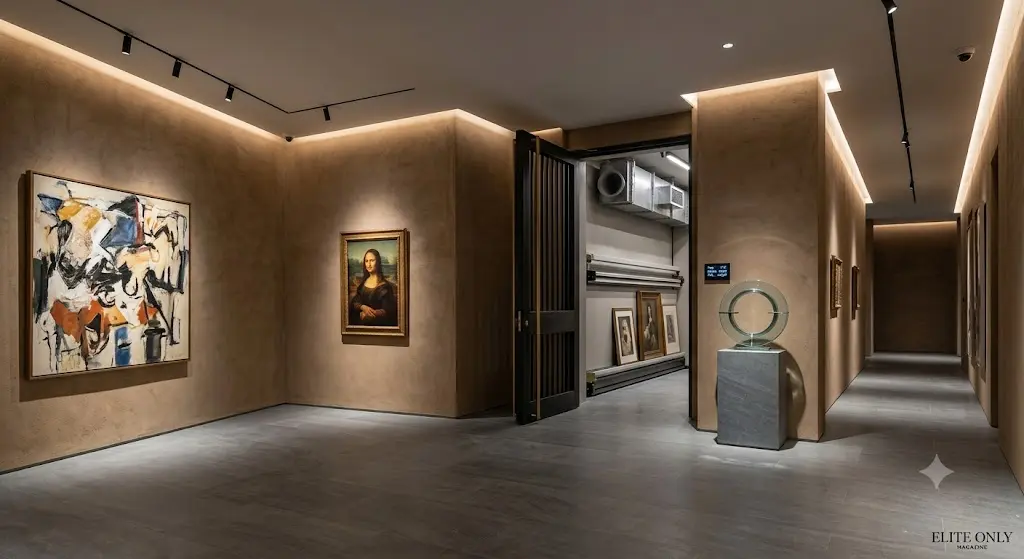
The Residential Museum: Art as Architectural Anchor
For generations, estate art collecting was treated as an interior design afterthought—pieces were selected to fit existing wall spaces or complement a room’s color palette. However, mid-2026 market insights show a complete paradigm shift. Serious collectors now view their acquisitions as historic legacy portfolios that demand the same level of environmental stewardship as national museums, built directly into the home’s architectural blueprint.
Placing multi-million dollar canvases or delicate historical sculptures in standard living spaces exposes them to subtle but devastating environmental stressors. Fluctuating humidity stretches and cracks oil paint, ambient dust creates microscopic abrasions, and standard residential lighting cause irreversible yellowing. True collection optimization demands a dedicated, structurally independent gallery ecosystem where fine art can breathe safely.
The Hidden Mechanics of Preservation
Engineering a sovereign home gallery requires a highly specialized configuration of mechanical and atmospheric controls concealed behind flawless architectural finishes:
- Ultraviolet-Extinguished Lighting Grids: Custom-engineered LED arrays emit entirely zero UV or infrared radiation, utilizing smart-tracking lenses that cast uniform light exclusively across the artwork’s surface while leaving surrounding borders in soft shadow.
- Micro-Climate Humidity Buffers: Isolated air-handling networks cycle highly filtered air at a fixed 21°C and an unyielding 50% relative humidity, preventing the microscopic fiber warping that destroys historic canvas tension.
- Vibration-Isolated Floating Foundations: To protect fragile sculptures and delicate mixed-media installations from the constant, low-frequency vibrations of residential life, gallery floors are built on subterranean neoprene isolation pads.
Sensorial Materiality: Crafting the Quiet Gallery
To ensure that a high-performance art vault feels like an intimate, soul-stirring sanctuary rather than a cold institutional archive, leading interior architects are utilizing a rich, deeply tactile material palette.
The modern standard for a 2026 private gallery combines honed Belgian bluestone floors with raw, texturized clay-plaster walls. The soft, hand-applied texture of clay plaster offers a completely matte, non-reflective finish that eliminates distracting light glare, allowing the true color profile of every painting to shine. The rich gray tones of the stone floor provide a grounded, weighted baseline, while the natural acoustic density of both stone and plaster naturally dampens ambient noise—turning the gallery into a quiet, meditative space completely optimized for visual appreciation.
The Curation Matrix: Standard Display Spaces vs. 2026 Integrated Art Vaults
When building out custom residential wings, premier developers contrast traditional luxury living spaces with advanced conservation salons:
| Preservation Metric | Standard Luxury Display Space | 2026 Integrated Home Art Vault |
| Atmospheric Shielding | Standard home HVAC (exposes art to dust and dander) | Positive static pressure with active VOC and particulate scrubbing |
| Lighting Architecture | Recessed incandescent spots or direct natural sunlight | UV-free spectral tracking grids with zero infrared emission |
| Acoustic & Wall Profile | Painted commercial drywall (highly reflective) | Sensorial Warmth via texturized clay plaster and honed stone |
| Structural Stability | Standard residential subflooring and framing | Subterranean vibration-isolated floating foundation slabs |
The Ultimate Philosophy of Art Stewardship
“In 2026, the true measure of a collection’s value is found in the respect shown to its preservation. We do not own a masterpiece; we merely guard it for the next generation. Framing these cultural artifacts within permanent, organic materials like texturized clay and natural stone honors that responsibility—creating a space where creative human expression and timeless architectural permanence exist in perfect harmony.”
Luxury Art Curation 2026. Residential Art Vaults, Micro-Climate Masterpieces, Museum-Grade Lighting Design, High-Net-Worth Art Collections, Sensorial Gallery Architecture, Preservation Logistics.